Equities Outlook — Q2 FY 2026-27
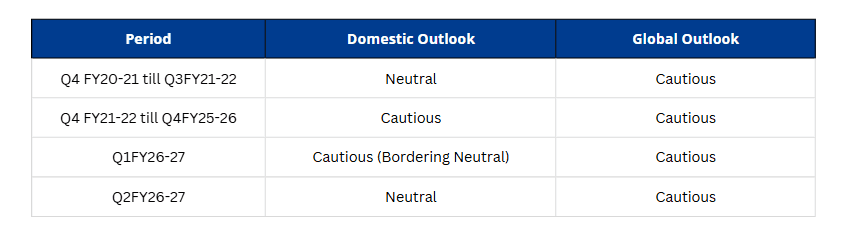
Almost at the 5-year bell, our tactical outlook on Indian equities moves from Conservative to Neutral. Tailwinds: normalising valuations, quarterly profit pickup and macro credit creation. We suggest rebalancing to a neutral allocation, hastening deployment and reshaping equity portfolios.
Executive Summary
Almost at the 5-year bell, the research desk at Box Wealth Advisors has updated our tactical outlook on Indian Equities from a Conservative to a Neutral rating.
The key tailwinds supporting this are normalisation of valuations, pick-up in quarterly profit growth and the macro credit creation rate.
Custom Action Points
- Asset Allocation: Rebalance and increase from a conservative allocation to a neutral % allocation within the corridors pre-defined in your Investment Plan.
- Hasten the Deployment: wherever systematic transfer deployments are going into domestic equities, increase the velocity / quantum.
- Reshape the equity portfolio itself — from a defensive make to a neutral / cyclical portfolio construct.
Your wealth team will work closely with you on handholding you through these.
Valuations: Neutral
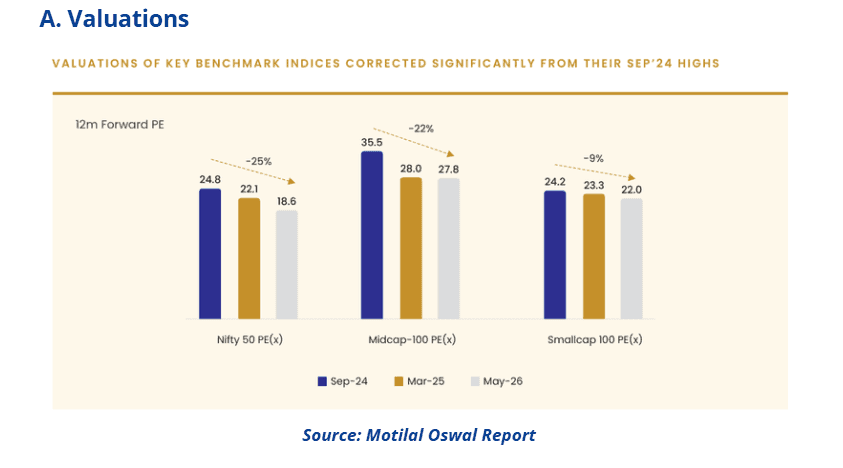
Valuations have moderated significantly, particularly in large and mid caps, improving overall market risk-reward. However, the smaller correction in small-cap valuations indicates that selectivity remains important.
Earnings Growth: Neutral to Positive
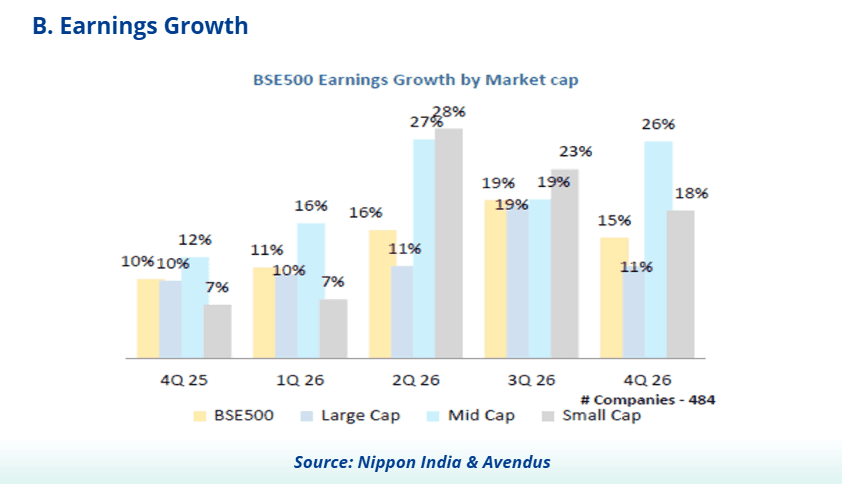
Q4 FY26 earnings remained healthy across market-cap segments, led by mid caps, while estimates for Q1 FY27 also indicate continued earnings growth despite higher input costs arising from the Middle East conflict.
Relative Valuations: Neutral
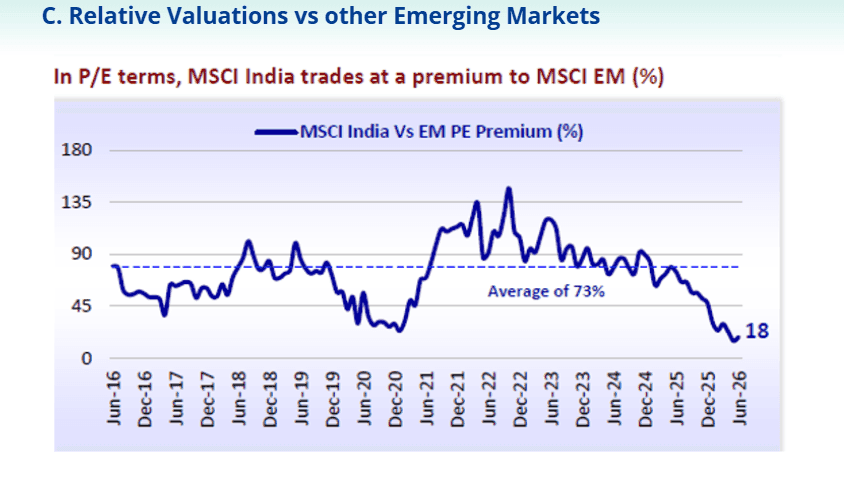
Indian equities continue to trade at a premium to other emerging markets, but the premium has compressed sharply from the peak and now stands at approximately 18%, well below the long-term average of 73%. This valuation normalisation improves India's relative risk-reward.
Nifty 50 Valuation Signals: Positive
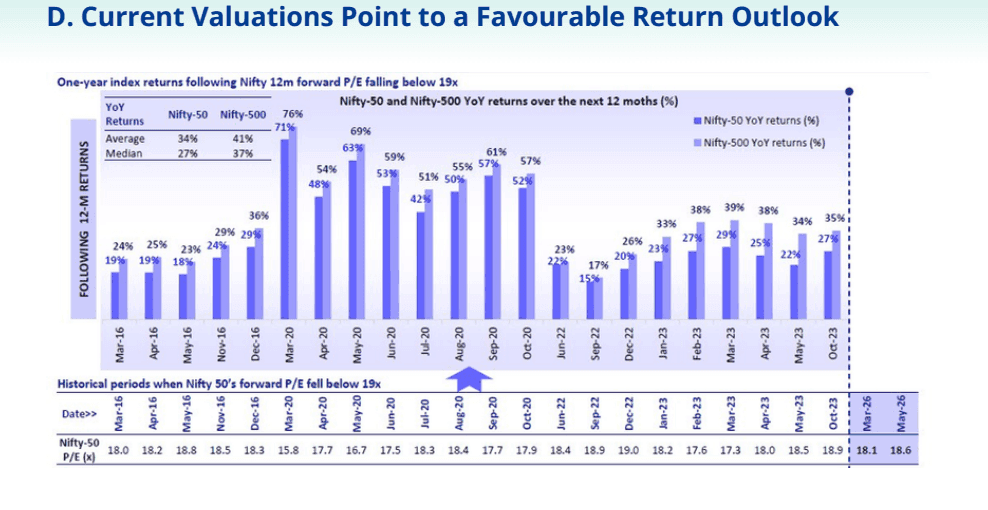
Historically, when the Nifty 50's forward P/E fell below 19x, it has been followed by strong 12-month returns across Nifty 50 and Nifty 500. With the current forward P/E around 18–19x, valuations appear relatively reasonable, indicating a favourable risk-reward setup for Indian equities.
Key Things to Watch Out For
- Earnings: Sustainability of the recovery and potential estimate revisions.
- Crude Oil: Impact on inflation, currency and corporate margins.
- Monsoon: Effect on food inflation, rural demand and consumption.
- FII Flows: Sensitivity to global yields, relative valuations and currency movements.
- Global Risks: Geopolitical escalation or a slowdown in major economies.
Our Opinion
With valuations moderating and earnings expectations remaining constructive, investors currently positioned at the lower end of their Strategic Asset Allocation (SAA) for equities may consider gradually increasing their equity allocation towards their TAA through a systematic approach.
Annexures
A. Valuations
1. Why India has historically traded at a premium
Higher structural growth: India’s faster economic growth and expanding domestic consumption support stronger long-term corporate earnings potential.
Quality and diversity: A broad mix of profitable private banks, consumer companies, IT, healthcare and industrial businesses commands higher valuations.
Stable domestic flows: SIPs, mutual funds and insurance savings provide consistent market liquidity and cushion periods of foreign selling.
2. How relative valuations affect FII allocation
Active FIIs: Shift capital toward markets offering a better combination of valuations, earnings growth, currency outlook and sector opportunities.
Passive FIIs: Follow benchmark weights rather than valuations directly, buying or selling as each country’s free-float market-cap weight changes.
Indirect link: Attractive valuations can draw active flows, improve relative performance and raise index weights, subsequently triggering passive inflows.
Present and forward implication:
India’s sharply lower valuation premium may encourage active FIIs to reduce underweight positions, but sustained inflows will depend on stronger relative earnings growth.